Sunday, November 13, 2016

Lean First means Customer Discovery before Product Development

I regularly get people contacting me to talk about their startup and the work they are doing. Frequently they are very very busy doing startup-y things like managing their team, organizing their tasks, raising money... But strangely, not really doing any significant Customer Development. I have run several experiments now where I have made them an offer to take a small time-out, and to run a Lean Startup Experiment to do just one Build-Measure-Learn loop in a formal and transparent way. My experience is that there is serious significant resistance among entrepreneurs to really talk to real customers.

As a person who believes deeply in the Lean Startup methodology, I would start the conversation urging you to stop building your prototype. Clear the space for you to do significant customer engagement.

The Lean Startup idea is that you put Customer Development before Product Development. That is you talk to , understand and adapt to a customer base, discovering and validating your customers before you build things.

You have three main risks:
1) Technical Risk - Can it be built
2) Market Risk - Should it be built
3) Execution risk - Can my team build it

These are in order. Chances are, you do not have technical risk.
And Chances are that you have not talked to enough customers to resolve that there are really customers who have a real problem that are really willing to pay you. (Note that there is a significant difference between the 98% of people who are cheerleaders that tell you happy thoughts and the 2% of customers who really really really are ready to pay you now to solve a problem)

You need to find 100 customers who really really really want to pay you now to solve a problem; before you take one more step on building the product, find those 100 people.

I recommend that you read these three books, in order:

Running Lean by Ash Maurya
Lean Customer Development by Cindy Alvarez
Scaling Lean by Ash Maurya.

And I recommend that you get the Startup Owners Manual by Steve Blank, and strive to read one page a day. Keep reading pages one at a time until they start falling into place.

This would allow you to get focus on this Customer Development before Product Development.

If you are ready to take a leap into a Customer Development experiment, take a look at the work of Adam Berk ( @adamberk ) as outlined in http://www.oomaat.com/2016/10/just-one-lean-experiment-to-progress-to.html

Remember in the Theory of OOMAAT, your first step is to find just one customer. Don't think about anything more than things that lead you to your first paying customer.  Then we can worry about how we might get to ten paying customers. 

Friday, November 4, 2016

Standups every 90 minutes at a Startup Weekend? Why?

Tonight, I am facilitating another Startup Weekend. It will be my 55th startup weekend event. When I do a startup weekend, I try to engage the group in regular standup status meetings every 90 minutes. 

Startup Weekend is a business sprint. Trying to get from idea to revenue in a weekend, with a group of strangers. The surprizing thing is that 11% of these teams formed over the weekend are alive a year later moving money. ( I suspect that the teams made up of people who have been to several startup weekends because we have such a high return rate for participants. )

If we are able to get the teams formed, seated and working by 9:00pm on friday, that gives us time to get two standups. One at 10:30 and one at midnight.  And then over Saturday, to do standups at 10:30am, Noon, 2:30pm, 5:00pm, 7:30pm.....

I just read the article by Jason Fried on Medium - Status meetings are the scurge - https://m.signalvnoise.com/status-meetings-are-the-scourge-39f49267ca90#.cn3v2wyb9

And I am sure that the Technical coders in the room feel somewhat unhappy about all the interruptions. So.... Why would I want to continue this practice?


* Help people get to know each other
     It is frequent that teams hole up and never get to see others. By having to stand together, they at least get to see other people and to engage with them. All 100+ people stand up and circle up to do the standups. When they work right, 13 teams can be done in 8 minutes. 


* Use teams progress to focus the work of other teams
     When teams report out things that the other teams have not thought of, often they are able to get those things one the task list and going much much faster. 

* To break attention to "too big to do" tasks into smaller pieces
      It is frequent that people have big fuzzy ideas and have not figured out how to drive them down to small manageable tasks. By breaking things into very small sprints, we are able to get people to focus on things that move the ball forward faster. Instead of being lost in the midst of a fuzzy swamp of ill-formed ideas. 

* To force people to physically move and increase productivity
     When people get up, move, push the blood around, they come back a bit more energized and a bit more focused. Without these breaks, people tend to get a bit fuzzy headed. A weekend is a long sprint without breaks. 

* To enable people to interact between teams more over the weekend
      By actually physically seeing everyone together, it creates many more relationships over the weekend, than when people are only talking the whole weekend to their 6 team members. 

* To help team leaders be seen as leaders
       By having the team leaders report out, we help them be better known in the community and help them reenforce their role on the team.

* To build a sense of urgency
      If every task you are doing has to be small. Think Pomodoro (25 minute tasks), then the need to do something now gets stronger. The whole "No Talk, All Action" motto is focused at this idea of doing instead of discussion. If you can't decide in 5 minutes, flip a coin. If you can't get the task done in 25 minutes, break it up into smaller pieces. 

     With Pomodoro (25 minute sprints) and a team of 8 people, with 20 hours of real working time, you should be able to get 8 * 40 = 320 tasks in the weekend. For many this is more progress than most people make in a month. 

* To really drive forward the sense of small rapid iteration
      If all of you tests are designed to be answered in 90 minutes, you will learn much much quicker than if your tests are designed to be answered in a day. By using the Build-Measure-learn process with very quick iterations, you make much faster learning.

Most people have habits that make it hard for them to make rapid progress. By doing standups, we drive some of those habits away , at least for a weekend. 

This weekend, I will experiment with using Slack + Trello as a tool and see if this helps any of these areas. Perhaps there are some ways to get people to be more effective with less interruption. However, moving your body and meeting other people are in some cases more important that staying in the current task that is taking way way too long to be effective.

Friday, October 21, 2016

Just one Lean Experiment to progress to a Data driven Startup


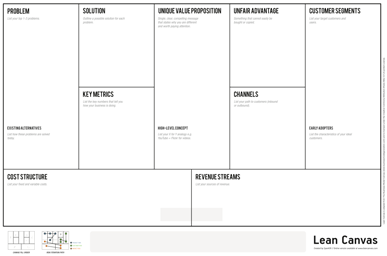
When people use the Lean Canvas well, not only do they fill out the canvas, they generate hypotheses and then run tests around each of the hypotheses to see which are valid

That process includes something like:

  •  Make a hypothesis
  •  Craft a test of that hypothesis
  •  Have clarity on the success metrics
  •  Execute the test
  •  Report out on the results of the test
  •  Make a plan for the next cycle ( Perservere or Pivot) 

@adamberk put together the MilValChal to explore a process to engage more deeply in running customer development tests.


https://medium.com/@adamberk/01-for-your-thoughts-100-for-your-startup-hypothesis-789562799f10#.ngdy9ysqx


The goal is to help people make more effective progress towards doing a complete experiment cycle, with the belief that transparent experimentation will lead to value creation at a higher ROI than not.

We have been having a conversation about how to help people focus on the basics of doing explicit experiments. So very often people skim through the experiment effort jumping directly to the conclusions they already had in mind. In our discussion about how to move people forward, we discussed doing a single full experiment. We want to bring the MilValChal vision together. So we want to experiment with having people do one complete experiment. 

To bring people full circle through one complete experiment, @adamberk has $25K to help 25 companies make focused progress to complete a Lean Experiment. He will pay out $100 to as many people as fill out the first half of the Experiment Report Board (left side) within a week of this post being published and $900 to anyone (of those people who enter the funnel in the first week) who fills out the second half and writes a medium post sharing their learnings and next steps based specifically on those learnings.


To collect the $100, you must do the following

  • Accept the challenge publicly by going to bit.ly/libertyventures and entering your email
  • Click to tweet
  • Tweet a copy of the left side of this canvas filled in CORRECTLY or make it to column 3 of this hypothesis board

For you to get this $1000, do the following:
Complete a single experiment cycle (it is harder than it sounds!)

In the SUBJECT of the email write = “My is, my Twitter is . A Lean Experiment:

In the BODY of the email write = “I believe that 15 submitted Interviews will prove that out of of <$Y> who are will take by November 1st, 2016.

You will have a significant number of experiments ahead of each of these key milestones:
  • Customer/Product fit
  • Product / Solution Fit
  • Customer / Solution / Value proposition Fit
  • Clarity on Existing alternatives
  • Clarity on where to find early adopters
  • Clarity on the Revenue/Expense fit
  • Clarity on the Sales Funnel Metrics mechanisms

If there is an experiment proving each of these milestones, the chances of your startup having a good foundation are greatly improved.

This pathway starts by doing one experiment. Will it help you to do a complete experiment to start with this $1000 challenge?

http://bit.ly/libertyventures

Tuesday, February 16, 2016

The Startup experience: Linear vs Exponential


When you are starting a company, the week by week growth rate is important to track. Initially, it will be very chaotic. Hopefully, early on, you will find a way to make your revenue process predictable. Investors are looking for evidence of this predictability. They are also looking for something else. They are looking for evidence of growth. When they are thinking about growth in revenues, they are looking for a percentage growth on a week by week basis. More data points can help you get a handle on the foundations of your business model. 

Looking at the curve above. This company starts with $1000 Monthly Recurring Revenue (MRR). The blue line represents an initial growth rate of $100/month, which is 10% growth in the first month. The Orange line represents a Monthly growth rate of 10% a month, month over month. While the Red line represents a 5% month over month growth. 

All of these start out at the same point, but the 10% month over month growth quickly outstrips the linear growth. At the end of 3 years (36 months) , the 10% growth represents a 5X increase compared to the 5% growth curve. 

More interestingly, while the linear growth started at 10%, by month thirty, it has crossed over and is the same as the 5% curve. 

When you are looking at your growth oriented startup, you should be looking at at least kind of exponential growth. That is growing at a regular X% growth month over month. 

If you have a 10% month over month growth, your company is approximately a 3X company. If you have 20% month over month growth, then your company is a 9X company. If you are aiming at a 10X company, you need to reach 22% month over month growth on a sustained basis. 

Sunday, February 14, 2016

Cashflow Projection: A Pillar of your Startup


The last two boxes in the Lean Canvas are Income and Expense. From a canvas point of view it is meant to get you to be thinking about the key factors involved in your business. However, the point of the Lean Canvas is to built the foundations of your business model. To get your model to a sufficient level of detail that you can use it over time, you build a cashflow projection.  Each of the details of your startup that are critical to the business process will show up in this spreadsheet.

Each box of the Lean Canvas provides assumptions and critical factors for your business model and they will form the basis of your cashflow spreadsheet. As you run your business, you will want to compute and recompute how your business model as represented by the spreadsheet matches up with the actual results that you see in your business. You will want to do this on a weekly basis. 
Looking at the graph above, we see a business that is subscription business, which has very limited expenses and which has a 15% growth rate as the basis of this chart. The ongoing expenses over whelm the income for a long time. While we see the income starting to turn the corner, this business will be cashflow negative for more than 3 years. 

However, small changes in growth rate can change the experience dramatically. 

This next graph is the same company, but with a 25% growth rate each month. This is a company , which is a 10X company, but in order to survive, it will need to take $200,000 in outside funding. 


With this new cash infusion, the company is able to remain solvent, at least in this model. However, if the growth rate was higher , with just a 30% per month growth rate, that same company would not need to take outside money at all. 
The small differences in revenue and the growth rate of the revenue can make substantial differences on the lifespan of your company. Digging into the details of the consequences of your assumptions will be vital to your progress. 


​There are several key factors you need to work with:
  • The initial amount of cash you bring to the company
  • The point at which you run out of cash. Which is determined by your Burn Rate. This company has a one year Runway
  • The point at which you get to cash flow positive.
  • And the point that you break even. 
Spend the time to build  and then regularly revise your cashflow projection for your startup. 


Tuesday, April 28, 2015

Throwing out good work

“You did great work on the scenario documents”, I said. They really were a lot better. The language was clearer, the instructions for the readers were better and the actual stories were more to the point. A major improvement, after having struggled with the scenarios for months.

“We decided to throw them out of the game altogether”, I continued.

Katie looked understandably confused. Didn’t I just say that they were much better? Had all the work gone to waste?

Making Playing Lean, the board game that teaches Lean Startup, has been a great challenge. Besides the actual playability of the game, we have had to make sure that there are enough startup lessons taught for the game to have value. Finding that balance had been a major part of the job.

That is why we introduced the scenarios. They were documents describing the beginnings of well known companies in a familiar industry. The first go was at Social Media. Players could be Friendster, Myspace, Facebook or Twitter. The outcome would be up to the choices players made, counterfactual history in the making.

Except something always felt wrong with them. It felt forced, we had to keep reminding players to read them out loud. Reading became a little awkward as the game progressed, but we could not really put our fingers on why.

We just assumed that it was because the quality of the documents themselves were so poor.

When the typos were weeded out, the structure was better and everything was much improved, it only took one playtesting to realise it: The scenarios had to die. The concept still felt forced and awkward.

Though the actual writing was discarded altogether, it lead to a major improvement in the game.

The broader lesson is that we fell into a trap. We convinced ourselves that the quality of our work wasn't good enough, that we could not rely on our testing until there had been major improvement. This made us discard a lot of of good feedback.

It may sometimes be the case that low quality experiments gives the wrong idea about an experiment. But be aware, it is a dangerous line of thinking. At the extreme end of it, only a fully functional, thoroughly designed and well engineered product can invalidate your idea.

It is important to be pay attention to what kind of people you are testing on as well. Some testers are more inclined to look past visual design and basic quality issues and evaluate the core idea of a product. Others won't get past the typos and poorly matched colors before they pass negative judgement.

Before my next experiment I will ask myself: What kind of people am I testing with? How high must the quality be before I will accept a negative result? It may just save me, Katie and the rest of the Playing Lean team a lot of time.


Twitter: @simenfurLinkedin: https://www.linkedin.com/in/simenfur
Website: www.playinglean.com
Bio: Simen is the CEO of Iterate, a consultancy based in Oslo, Norway. He is also the co-creator for Playing Lean, the board game that teaches Lean Startup.

Friday, February 14, 2014

Startup Weekend as a game of Pickup Ball

Startup Weekend is a great way to sprint from Idea to Revenue in a weekend. I am thrilled with some of the results that I have seen. However, when I encourage people to engage in a startup weekend, I often get resistance. "Oh, I already have a startup" or "Oh, I don't have an idea" or "I am already happy working at XYZ Big company"

Startup Weekend is a skill building sprint. It creates urgency and focus, which allow you to learn things faster than you would in most other contexts. Just as when you do pushups and situps to prepare for your marathon run, Startup Weekend gives you a chance to build skills and connections that are hard to get other ways. 

Think of Startup Weekend as a game of Pickup basketball. It may not take you into the big leagues, but it does let you practice that shot in a way that makes you stronger and faster. 

Every weekend, there are over 1,000 people who are out picking up some new skills, trying new roles and exploring new ideas. Even if you are at XYZ Big company, or are already deep in a project  with a startup, Startup Weekend will give you a chance to gain some new muscles.